

“Wherever you go, there you are.”
-Professor B. Banzai
The era immediately succeeding the battle of Bassen Rift was a time of strife for many of the galactic powers, marked by loss and uncertainty. The destabilization of the Romulan Star Empire by Shinzon’s revolt and the subsequent destruction of Romulus itself by the Hobus supernova left millions of people dead and countless more displaced and suddenly without a nation to call home. Initially, Starfleet’s response to the crisis was to render aid as soon as logistics would allow. Positively ancient ship classes would be briefly returned to service to act as evacuation craft, and several new classes which had languished on drawing boards finally received the funding needed to be brought to life. Among this new breed of Starfleet ship would be venerable names such as Enterprise, Verity, Olympic and Endeavour. But this era would end just as violently as it had begun when an attack on the Sol-system’s famous Utopia Planitia left the Romulan evacuation effort dead in the proverbial water, and the Federation without one of its most important shipyard facilities for the better part of two decades.
The intervening years, Starfleet’s remaining facilities would participate in several projects intended to replace ship classes which relied on special components and tooling lost during the attack on Mars. One such project was dubbed Project Rebirth, and these vessels would, unlike similar efforts at the reclaimed Yard 39 facility, each make use of several standardized components to offer ease of manufacture and a measure of redundancy. Warp engine nacelle housings, deflector assemblies, weapon systems, and even bridge modules would be built to standardized set of specifications, allowing for maintenance efforts to draw from a common pool of replacement parts.
From this program, four classes would emerge: the 4-nacelled Sagan-class, the sturdy combat oriented Duderstadt-class, the graceful Excelsior II-class, and finally, the now-famous Constitution III-class. With construction of all four well under way at the San Francisco and Tycho fleet yards, we’ll be taking this opportunity to look at the inheritors of both the Excelsior and Constitution class legacies, starting today with the Constitution III, otherwise known amongst the fleet as the “Neo Constitution”.
The Constitution III is a distant development of the Khitomer-era Shangri-La-class and was originally conceived as a morale project meant to provide a symbol of hope to the Federation, deliberately hearkening back to what many saw as the UFP’s “golden era”. Not a knife fighter like the Gagarin or Duderstadt, nor a battering ram like the Sovereign, the “Neo Constitution” was instead meant to be the next great explorer of the fleet. To that end, designers looked to successful types then already in service, such as the Luna-class, to see what worked and what didn’t.
Computer systems, warp engines, defensive and offensive systems, as well as major structural components were all evaluated for reliability, efficiency and ease of use over the course of an intensive 8-month period, with a final report informing what would eventually become the core of this new iteration of a legendary class. The outcome was not flattering; the events of the Dominion War as well as the power vacuum in the wake of Romulus’ destruction meant that vessels nominally classified as “explorers” were in truth little more than warships with a thin veneer of scientific utility applied. Lateral sensor arrays better suited to target tracking, weapon systems geared more toward ship-to-ship combat, and deflector shield systems focused on repelling weapon fire rather than environmental hazards. Even the Luna itself coopted to become little more than an Akira without a flight deck.
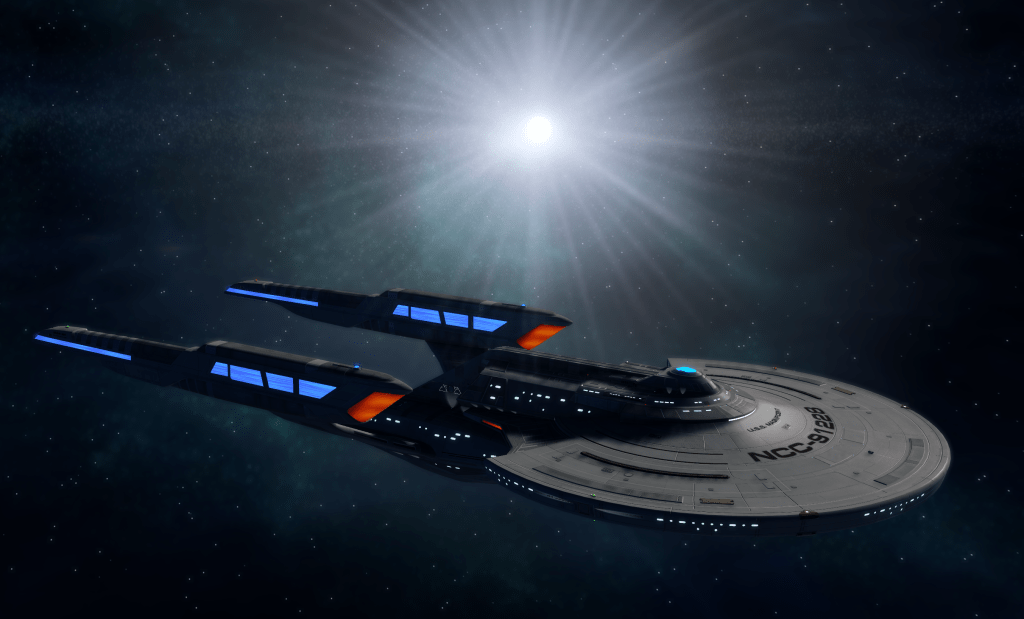
At 560.5 meters in length and spanning 28 decks, the Constitution III is built around an extensively reinforced neck structure mated to a large impulse assembly, featuring several design cues taken from the Constitution II that include the profile of the primary hull’s leading edge as well as a portion of the earlier class’s weapon layout. Utilizing the same astrometrics, stellar cartography and primary computer core facilities as the Luna-class and surmounted by the bridge module common to all project Rebirth starships, the new ship is equally at ease as a pathfinder as it is navigating densely populated core star systems.
Defensively, the Constitution III makes use of the now standard layered approach with both standard deflector shields as well as metaphasic shields, allowing the ship to be equally capable of protecting itself from belligerent vessels and environmental hazards. This, combined with the design’s extensive observatories made the Constitution III well suited to the task of monitoring stars in nearly all stages of their lifecycle, leading several observers to posit the theory that this capability was in direct response to the Hobus crisis.
Blurring the line between a defensive and offensive system, the Constitution III is one of the first vessels to make use of a combination of ball turret and collimating strip phaser emplacements. While many were left wondering if the inclusion of old-fashioned ball turrets was simply a holdover from having been based on the Shangri-La class, the truth is far more interesting. Weapons tests undertaken during and after the Dominion War showed that ball turret emplacements of the Mirandas, Centaurs and Excelsiors were much more adept at tracking and intercepting small, fast-moving targets such as fighters or projectiles than the collimating strip arrays found on larger and newer ships active at that time. With this information in hand during the initial design phase of the Constitution III, the unorthodox decision was made to include both systems, intending for the ball turrets to see the most use for engaging and eliminating interstellar debris too large to be handled by deflector shields, while strips would remain the weapon of choice for engaging other ships. A total of 18 arrays spread between 4 strip emplacements and 7 dual turret emplacements would be included in the final design, supplemented by 2 rapid fire torpedo launch tubes (one facing fore and one aft).
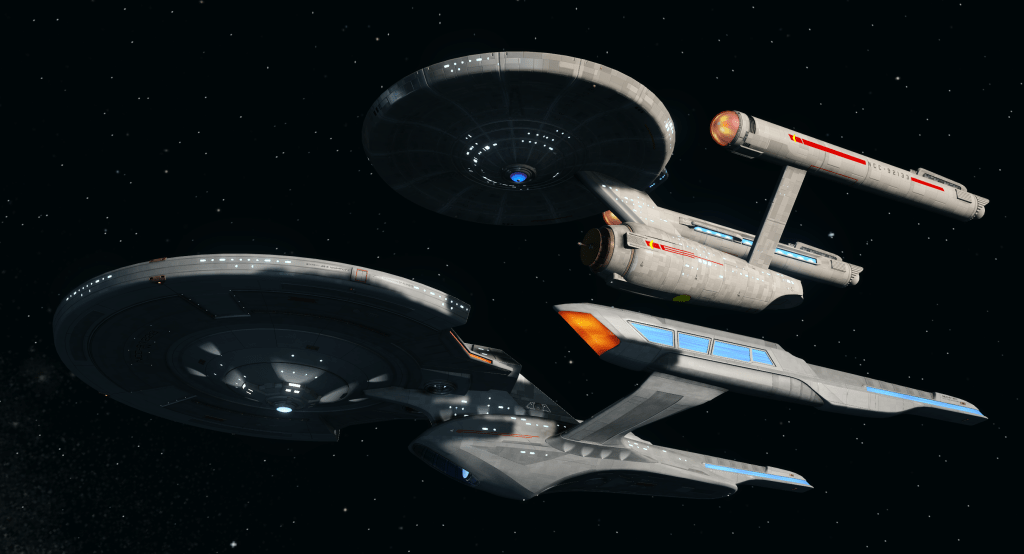
Main power and superluminal propulsion would be provided by a standard matter/antimatter reaction assembly and electro-plasma distribution grid connected to a pair of PB-99 nacelle housings utilizing the same type and configuration of warp coil common to the Luna, Akira and Steamrunner. By continuing the theme of parts commonality amongst fleet mates, the Constitution III’s designers provided a power plant that was at once familiar to engineering crews while also easily serviced, reducing the amount of time spent in drydock between assignments. This combination of systems provide the Constitution III with a sustainable cruising speed of warp factor 6.6 and a maximum emergency velocity of warp factor 9.99. Now, in 2411, the inclusion of quantum slipstream drive as a standard system, it is expected that the Constitution III will be refit to include it in short order, rendering the class capable of speeds and distances unthinkable when the design was originally finalized.
It is worth noting at this point that none of these systems would be of any value whatsoever without a capable command and control center to control it all. Reiterating that the Constitution III’s bridge module a standardized unit in use by the Sagan, Duderstadt and Excelsior II, it is important to explain that the standardization goes beyond bridge module itself. To ensure that the bridge was capable of being exchanged or replaced easily, designers had to ensure that data lines and the Constitution III’s EPS grid were also standardized up to the point where connections are made during installation. Once a physical connection is established, it is a simple matter of updating the module’s operating system to communicate with the central computer core and engineering subsystems. A unique emergency system featured by this module is a set of retractable blast doors integrated with the forward bulkhead of the bridge itself. This system was somewhat sardonically nicknamed “Blass doors”, following an incident aboard USS Constitution while still in drydock for fitting out where a member of the design team named David Blass demonstrated the utility of the system by using it to vent the unoccupied bridge into space to extinguish a fire caused by an EPS relay that wasn’t properly grounded during installation.
The Constitution III was met with mixed reviews upon acceptance to service, with some seeing the retro design as being “out of place” in an era where leviathans like the Odyssey and Sovereign classes exist, and still others questioning the wisdom of a purer exploratory platform in an increasingly hostile galaxy. However, nearly all these criticisms were silenced following the Frontier Day disaster of 2401. During the planned festivities of that year, a Borg incursion compromised the fleet, leading to significant damage to both ships and Probert Station. During the ensuing chaos, the Constitution III-class USS Titan-A was able to hold off the compromised fleet long enough for the reunited crew of the USS Enterprise-D to locate and destroy the source of the Borg incursion. During the engagement, not only did the layered defensive systems withstand the massed fire of several Starfleet ships, but the vessel’s impulse and RCS systems allowed the ship to outmaneuver most other ships present.
“Battle-tested” and finally having widespread acceptance amongst personnel, the Constitution III is expected to have at least 12 examples of the class in service by 2412 in what the Admiralty is calling its “12 for 12” initiative. With the Yorktown-class USS Enterprise-F due for her midlife refit and review, the rumour mill is rife with talk of retirement. These rumours are further fueled by the 12th Constitution III still being unnamed at the date of this publication.
 Tranquility Press
Leave a comment