
“We came to realise – first with astonishment, then bitterness, and finally with indifference – that intellect apparently wasn’t the most important thing…not ideas, but the system; not freedom, but drill. We had joined up with enthusiasm and with good will; but they did everything to knock that out of us.”
-Erich Maria Remarque “All Quiet on the Western Front”
In all the known universe, there are countless planets and countless peoples inhabiting them, and plying the space between them, starships of all shapes and sizes travel the cosmos, bringing life and taking it in equal measure. Some species, like the Klingons, take to the stars in search of glory, finding meaning in combat, while others, like the Vulcans and Humans, left the cradle of their worlds to better understand theirs and others’ place in the universe. Since a fateful early April day in 2063, Humanity has found a higher purpose in not only exploring all that our galaxy has to offer, but in meeting other races, searching for kindred spirits with whom to venture forth in unity, as equals.
While that is well and good, not every species that we have met along the way has viewed us as potential allies or friends. Indeed, some see us as a threat to their very way of life. Such was the case in 2256 when elements of the Klingon Empire instigated a war with the United Federation of Planets. While the war was short, its brutality and mortal cost lead to a period of cold war between the two powers which influenced a great deal of technological development for the better part of a half-century; a 5-decade long arms race between belligerents where each side sought to gain the upper hand. Coming to the fore during this time was the Bird of Prey. Already a staple of Klingon force projection, the addition of active stealth technology during the war of 2256 elevated the diminutive and nimble craft from a simple gunship into something which was truly a threat. Seldom seen after the Empire ceased active hostilities in 2257, Starfleet, eager to return to exploration, chose to ignore the potential threat for many years.
When the B’rel-class made its debut in 2286, and inside Federation borders no less, Starfleet Command could no longer afford to ignore the Bird of Prey. An immediate tender was issued for a frigate design which could serve as a direct counter to the B’rel, possessing not only advanced sensor systems, a high degree of maneuverability, but also sufficient firepower to quickly deal with any opponents ferreted out before they could pose a further risk to the rest of the fleet. Several proposals were submitted, including a heavily up gunned Oberth and yet another variant of the venerable Miranda, but the design which caught the favour of the Admiralty was a shape not seen since the very earliest days of the Federation, hearkening back all the way to Jonathan Archer’s era.
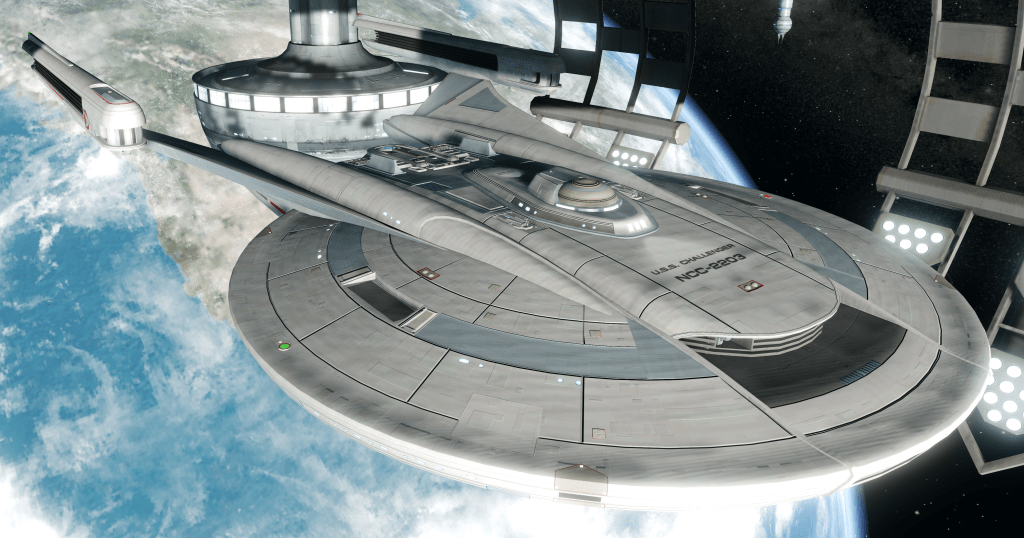
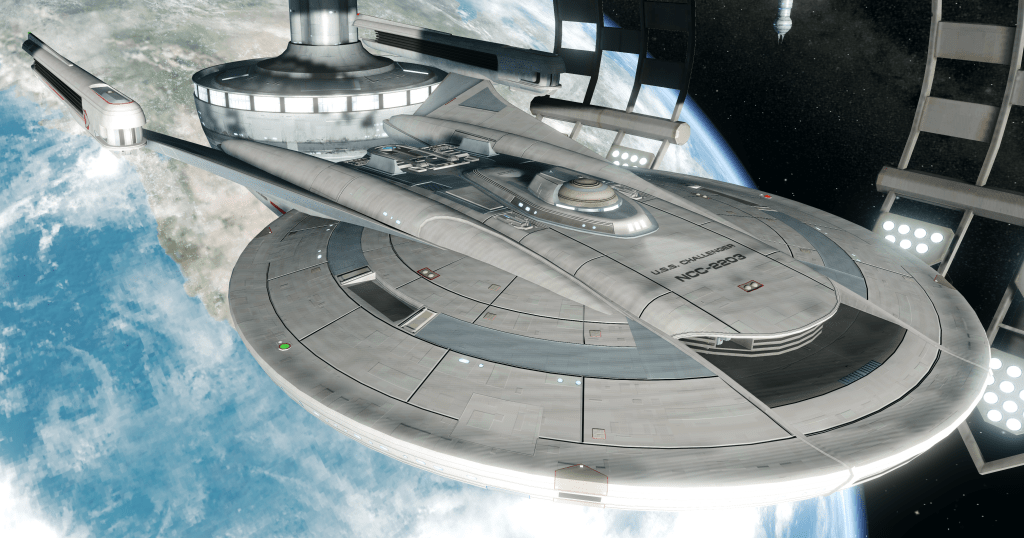
Dubbed the Columbia-class, this new vessel would follow the old NX-class’s rough planform, with a twin boom catamaran configuration, providing protection to the command deck from port or starboard approach angles. Like the Block II NX, the class would also include a secondary hull, but unlike the NX, which utilized a horizontal warp core for both installed cores, the Columbia made use of a modern vertical M/ARA running the full height of the ship’s 14 decks. Connected to the warp core via the Columbia’s EPS grid are a pair of armoured LN-70 drive coil nacelles provided by the Yoyodyne division of Utopia Planitia. Sharing architecture with Yoyodyne units in use with the Oberth-class, these units were designed to provide the Columbia with the ability to keep pace with other vessels in the Starfleet inventory to provide escort to vulnerable fleet mates through contested or dangerous territory.
To support this mission profile, and to help counter the threat posed by the B’rel-class Bird of Prey, designers chose once again to take advantage of the Columbia’s robust power generation capabilities by providing the ship with no fewer than eleven pairs of phaser emitters covering every possible approach angle while also allowing the type to easily outgun their intended quarry. In addition to what some historians consider to be an excessive phaser complement, the Columbia was also equipped with no fewer than 4 torpedo launchers, with two facing forward and two aft. Rounding out the ship’s armament, a pair of minelaying bays were incorporated into the ventral surface of the secondary hull, though these bays were never used in service, remaining empty.
Advances in shipboard systems in the century since Jonathan Archer’s first furtive steps into the larger galaxy meant that the Columbia’s crew complement of 75 officers and enlisted personnel would be half of what an NX-class was operated with during the Earth-Romulan War. Knowing that such a crew would need sufficient foodstuffs and other provisions for tours which could last for months or even years at a time without any access to fleet tenders or starbases for resupply made sure to design the class with large cargo bays in both the port and starboard sides of the primary hull. Accessed both through large hatchways in the underside of the saucer as well as via freight elevators up top, outboard of the catamaran booms, these bays could be provisioned quickly via workbee-tractored containers.
Lacking any significant scientific facilities beyond a full stellar cartography lab and observatory, the 75-strong crew enjoyed surprisingly spacious living accommodations despite the Columbia’s small size. Indeed, the class even featured an arboretum in the secondary hull, the smallest class to see service in that era to do so.
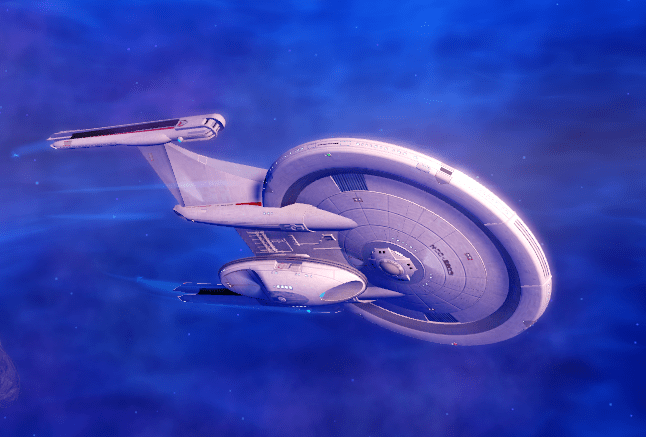
Finally entering service by 2293, the Columbia-class ended up becoming a victim of poor timing. Only five examples of the Columbia had been delivered and crewed by the time of the Khitomer Accords being signed that year, the arms reduction treaty included in the accords meant that further procurement was cancelled, though unlike the Constitution-class which was largely removed from service in favour of the Excelsior, already launched Columbias were retained for some years, seeing duty in anti-piracy patrols, only being withdrawn from service and mothballed in 2325.
Following the naming convention used for the NX, each member of the Columbia-class was named for a shuttle orbiter of Earth’s past, though Enterprise was already assigned to an Excelsior-class by the time the Columbia entered service. The class pathfinder, Columbia, was the first to launch, slipping her moorings in 2291, while Atlantis, Pathfinder, and Challenger all entered service with the type’s formal acceptance in 2293. Endeavour was the last of the class launched, in 2294, and along with Challenger, survived the longest in the reserve fleet following the type’s withdrawal from active service. Columbia herself would go on to become a museum ship assigned to the Memory Alpha facility where she remains to this day, having never been relocated to Athan Prime following that museum’s construction sometime in the middle of the 24th century.
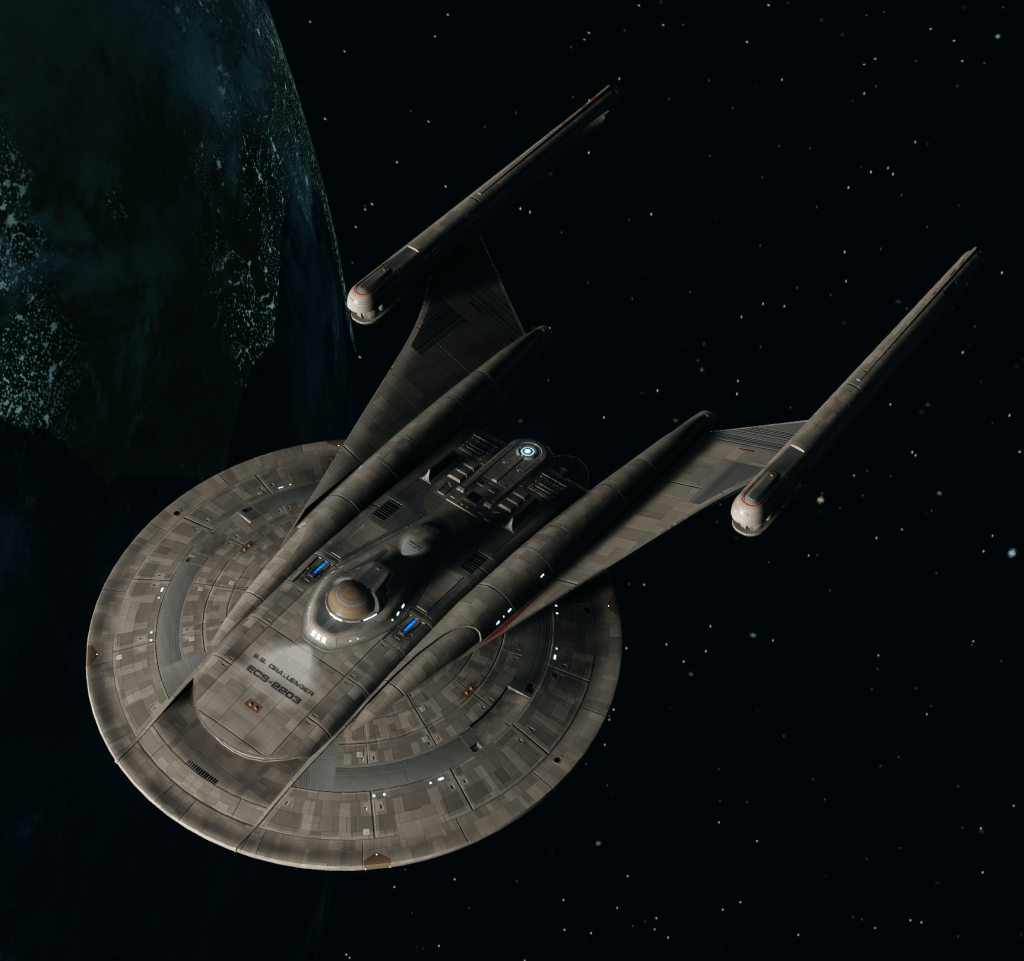
As of late however, it is not USS Columbia that is the most well-known representative of the class. That honour would be taken by her sister, USS Challenger, better known as ECS Challenger now. Discovered along with Endeavour at the surplus depot Z-12 by one Albert Carlson (ret), both stripped down hulls were purchased and taken in tow to a dock frame over Vulcan, where Carlson and a small crew worked to bring Challenger back to life using components cannibalized from Endeavour in addition to others either salvaged or bartered for from other sources. Registered with the Earth Cargo Service as an armed courier and light freighter, Challenger has been a common sight plying Federation space for both the ECS and other organizations. Carlson, a Starfleet captain who took early retirement following the end of the Dominion War, eventually passed command and ownership of Challenger to his son, Siward, in time for Challenger to participate in Operation Delta Rising as a support craft.
During the early stages of the operation, Challenger was operating between the Vidiian Sodality and a dangerous region of space known as the Nekrit Expanse when it detected and responded to an old SEPIRB signal. Following the weak signal, Carlson and crew would make one of the strangest discoveries of the operation when they found USS Atlantis. Lost for 88 years, Challenger’s sister ship was intact though showed signs of micrometeor impacts all along the hull plating. When investigating the interior, Carlson’s crew reported no signs of a struggle, even noting that the vessel’s shuttlecraft and lifeboats were still in place. Reporting their finding to Delta Alliance command and taking the seemingly abandoned ship in tow, Carlson returned to the taskforce’s base of operations and formally laid claim to salvage on the ship after gathering the crew’s personal affects for return to any surviving family.
Theories as to how Atlantis made its way to the Delta quadrant have ranged from accidentally stumbling upon a Borg transwarp conduit, the possibility of an unstable wormhole, intervention by the Caretaker, or more outlandish ideas like running afoul of a member of the Q Continuum. As to the crew itself, current theories suggest either contact with pre-cure Vidiian harvesters, or the more mundane possibility that they simply made a home for themselves with any one of many Delta quadrant peoples, leaving their ship behind in the process.
What is known for sure is that by 2411, the Carlson family now operates two of the original five Columbias for the Earth Cargo Service. Challenger has undergone at least one refurbishment since Delta Rising, while Atlantis was rechristened as SS Liberty (ECS-2201). In their lives as light freighters, both ships have had their ventral minelaying bays permanently converted into additional cargo space.

Find out more about Jane’s Interstellar at https://www.facebook.com/fleetsinreview
 Tranquility Press
Leave a comment