

“Man cannot possess anything as long as he fears death. But to him who does not fear it, everything belongs. If there was no suffering, man would not know his limits, would not know himself.”
-Lev Nikolayevich Tolstoy
The first step in Starfleet’s contemporary efforts to define itself more completely occurred in 2366, with the beginning of development for a small, unassuming vessel which would later become famous as the Defiant-class. The technical specifications of the class have been covered in detail in a previous publication on our service, so we will only reference them where necessary. The goal of this article is to examine and discuss the effect which the Defiant-class had on Starfleet from a philosophical viewpoint.
Since the arms reduction portions of the Khitomer Accords were ratified in the 2290’s, the fleet had expended great effort to restyle itself as a magnanimous exploratory organization. Indeed, for many decades thereafter, efforts paid dividends in peoples contacted and relations begun as multirole cruisers such as the Excelsior and Ambassador pushed the frontier of known space farther and farther outward. Ships in service to the Admiralty of course did so with a modicum of defensive armament, but never more so than needed to dissuade would-be aggressors. In fact, one of Starfleet’s greatest tactical engagements of the era was the defense of Narendra III by the Enterprise-C. While Romulan forces would eventually succeed in destroying the Enterprise, the ship’s show of bravery in the face of insurmountable odds did much to solidify the Klingon Empire’s belief in the validity of the Accords they had signed with the Federation.
Even as the 2360’s approached and Starfleet’s cruisers increased in size yet again with the development and launch of the Galaxy-class, equilibrium of power between the various interstellar nations of the Alpha and Beta quadrant ensured that new ships entering service only ever carried armaments proportionate to their size. The Galaxy-class was indeed a powerful ship, but the political environment ensured that significantly more effort was dedicated to civilian accommodation and creature comforts in order to better equip vessels for increasingly longer ranged assignments. It was during this time that development on a small more tactically oriented vessel began, intended to serve as an anti-piracy and escort ship for the fleet. Unpopular with Fleet Operations due to being seen as “too aggressive”, the basic planform of the ship would see itself be reworked into a potential replacement for the ageing Oberth-class. Dubbed the Nova-class, this new, state of the art vessel would go on to prove itself a capable addition to the fleet’s short range survey and transport services.
Just as the Nova-class prototype was due to begin trials in the Andor system, the Borg would attempt an attack on the Federation, engaging the fleet at Wolf 359 with disastrous results. Crews who had gone through training and deployment in a time of relative peace knew of battle tactics mostly as theory, with precious little in the way of practical experience. When the subatomic particles had settled, 11,000 personnel were dead and a staggering number of ships had been lost. Understanding for the first time since the 2250’s that not every encounter with a new power would be guaranteed to end peaceably, several crash-course development programs were started to address the fleet’s apparent lack of fighting ability.
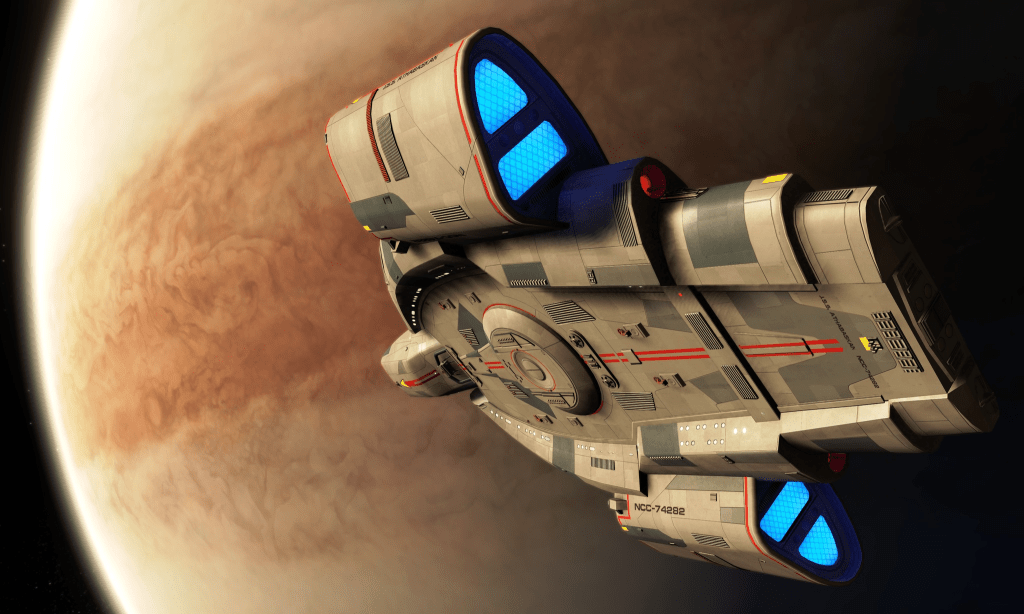
The original concept that had given birth to the Nova-class was revisited, with lessons learned from recovered wreckage from Wolf 359 informing changes in naval architecture. What resulted was an even more compact spaceframe that was described as “over-engined and over-gunned”. What the Corps of Engineers had done was give Starfleet its first dedicated warship. While yes, it could be pressed into limited service for scientific assignments, the vessel’s small size and cramped accommodations severely limited its utility in this regard. Kept at arm’s length and seen as a curiosity, the Defiant-class prototype would eventually be mothballed as the anticipated Borg invasion failed to materialize. Many within the Admiralty looked at the ship classes that had been developed as a dark chapter of paranoia that was best left to pass. Classes like the much larger Akira and Norway found themselves easily adapted to more peaceful assignments, and more time passed.

The opening stages of what would eventually be the Dominion War saw the Defiant prototype requisitioned by station Deep Space 9’s commanding officer, Benjamin Sisko for defense of the station and reconnaissance through the Bajoran wormhole into the Gamma quadrant. Following the loss of the Galaxy-class USS Odyssey and the formal outbreak of war, not only would the Defiant herself go on to prove the value of the class, but other ships originally designed to fight the Borg found themselves far more tactically capable than types such as the Miranda, Excelsior, and Ambassador. As the needs of wartime demanded, several members of the Galaxy-class would see themselves refitted into up armoured and up gunned command cruisers, though this was seen as a necessary evil with many uncomfortable with what they saw as the perversion of one of the Federation’s most well known symbols of peace and exploration.
The aftermath of the Dominion War forced Starfleet to become ever more introspective as the final tallies were taken and the war dead lain to rest. At the dawn of what we know as the modern age, the fleet was no longer simply an exploratory and defensive organization; it had also become a military force. This lead to a crisis as many who were uncomfortable with this shift in operation and philosophy chose to take early retirement or pursued careers in the civilian sector. Many older ships left over as surplus after the war saw themselves passing into civilian hands, where they would return to peaceful use, though without the cutting edge technology for which Starfleet was well known.
Hemorrhaging experienced personnel, the Admiralty had a choice to make and hard questions to ask itself; was there a balanced way forward that could satisfy both camps, and how to organize the fleet to accomplish this. It was understood that some things would have to be accepted as “the new normal” such as warships being a part of the fleet and tactical exercises being commonplace, but how to avoid letting that become the sole focus of development going forward. It was untenable to refit ship classes for combat, only to removed their additional weaponry and armour once a threat had abated; the time it would take to refit them yet again in a crisis would cost lives. Therefore, a proposal was put forward to separate the fleet into three distinct branches; tactical would be responsible for the vast majority of military operations, engineering would be responsible for not only continued development and testing of new ships and technologies, but also colony and starbase construction, while science would take on Starfleet’s exploratory and medical operations such as charting new systems, observing stellar phenomena, and disaster relief. Whenever possible, all three branches would be expected to cooperate on matters of diplomacy and treaty support, and in this combined capacity would go on to play major roles in the creation of the Khitomer Alliance.
While this was enough to win back many who had left in the wake of the Dominion War, there remains to this day a sizable number of people and organizations who are ill at ease with the idea of acknowledging the need for warships within the fleet, some of whom note the logistical nightmare posed by having such a diverse fleet with so many distinct classes. For the Defiant’s part, not only do examples of the original class remain in frontline service, but its descendants now also service the needs of not only Starfleet, but the Alliance, were they serve alongside one time adversaries in defense of a galaxy that has never seen its four quadrants so aligned with each other. Members of the Adamant-class escort relief convoys to worlds rebuilding in the wake of the Iconian War, while Aquarius and Eagles classes serve as both tender and bodyguard of the massive Odyssey-class and its own derivatives.
While the fleet continues to grapple with the dilemma of precisely what it is and how best to serve its varied interests, a family of ships once unwanted continues to be a common sight along the spacelanes.
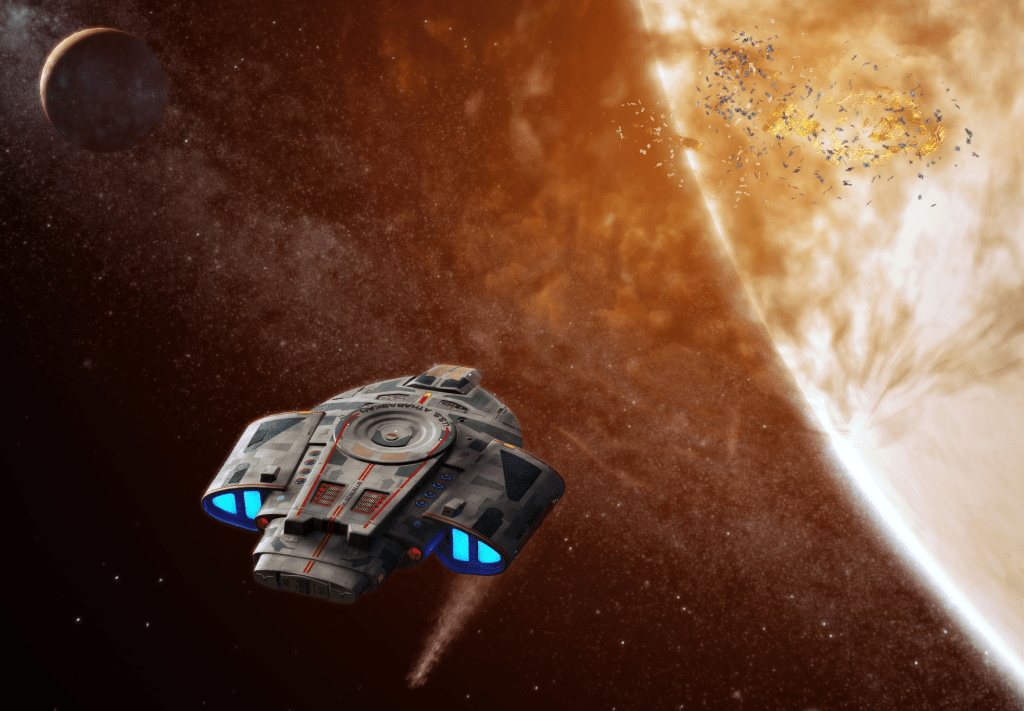
Find out more about Jane’s Interstellar at https://www.facebook.com/fleetsinreview
 Tranquility Press
Leave a comment