
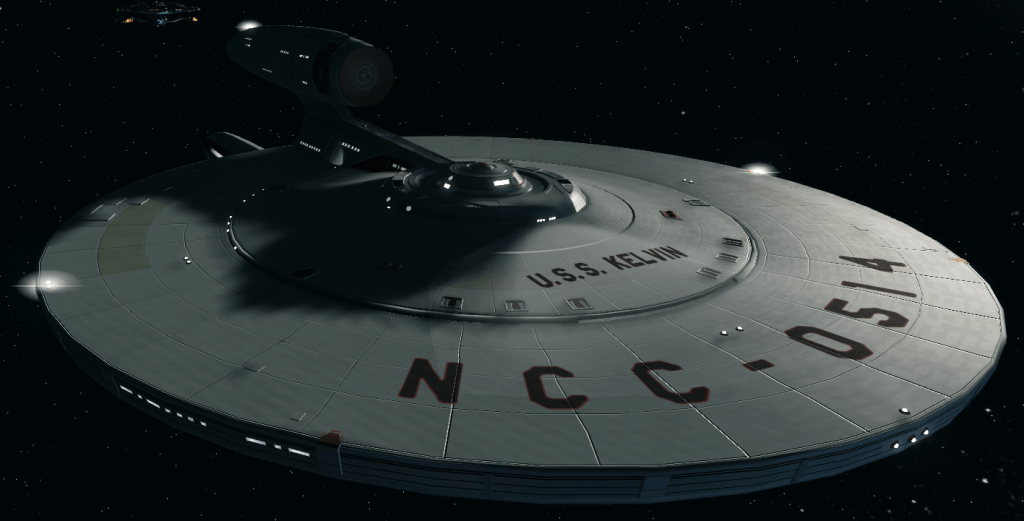
Tranquility Press is proud to support Janes’ Interstellar, and host their content on our site.
“Jim, you’ll be asked to make judgement calls in command that won’t be easy, and I guarantee that you’ll lose sleep over more than a few of them, but as long as you remember the difference between right and wrong, I think you’ll do us all proud!”
– overheard conversation between George Kirk and his son James upon the latter’s acceptance of the command of USS Enterprise (NCC-1701).
Designed to take the place of the then-aging Daedalus, the single nacelle Einstein-class would go on to become a workhorse for the fleet, serving first as a long-range exploration and colonization ship, then as an extended duration survey platform. Remaining in regular service with Starfleet for nearly four decades, the Einstein would also serve as the inspiration for several other successful ship classes, such as the Archer, Hermes, Saladin and the 24th century Freedom.
At 350 meters in length and spanning 18 decks, the Einstein was the single largest vessel in use by Starfleet until the advent of the Excelsior-class in the late 2290’s. Attempting to push the envelope as far as the technology of the time would allow, designers made the choice to incorporate significant facilities for resource processing and manufacturing, leading to a heavily industrialized interior. Much of the internal volume of the engineering hull was occupied by water purification plants and factories in addition to the vessel’s shuttle hangar and main power plant. Described as cramped, loud and uncomfortably hot while in operation, engineering crews were known to experience hearing loss and exhaustion at an accelerated rate as compared to their counterparts aboard other ship types.

The Einstein’s most distinguishing feature is its use of a single warp coil nacelle. To reduce the kind of structural vulnerabilities often exploited by Romulan commanders during the Earth-Romulan war of 2156, Starfleet engineers chose to forgo what had become the naval architecture standard of a twin-nacelle-secondary hull-saucer layout in favour of a motive component connected directly to the primary hull via a short and substantial pylon. Within this single monolithic nacelle, two sets of semi-circular warp drive coils were arranged behind an open Bussard ramscoop assembly, terminating in a massive thermal vent built into the nacelle’s tail cap. Needed due to the excess heat generated by all the systems being forced to operate in such close confines, this vent was often mistaken for an additional impulse engine, despite no measurable thrust being generated. Indeed, the vessel’s actual impulse manifold was located equidistantly from the nacelle housing and the secondary hull, along the trailing edge of the saucer section, in a location that remains the standard to this day.
Lacking the kind of forcefields that are now so commonplace, the type’s shuttle bay, located at the immediate aft of the engineering hull, was designed to be unpressurized during flight operations to facilitate the rapid ingress and egress of the type’s fifteen-plus shuttlecraft. Shuttle maintenance could be undertaken either with the use of environment suits or else when the bay door was closed, and the hangar was pressurized. The shuttles themselves were stored in a novel vertical rack system, and were accessed via individually pressurized gangways, ensuring that the craft could be manned and launched while the bay door was open. The shuttle bay also featured direct access to the ship’s main cargo bay, with the ability to rapid load cargo modules into storage via a freight handling system consisting of rails and rollers built into the hangar floor.
Compared to the conditions of the engineering spaces, crew accommodation and laboratory space in the primary hull was cavernous. Despite the large crew compliment, often of up to 800 personnel during a mission, individual quarters for the ranks of lieutenant and above were relatively common, with enlisted billeted four to a room on average. During emergencies, habitation spaces could be reconfigured to accommodate up to 1400 individuals for short duration, though during the type’s service life, this was only done a small handful of times. Surviving members of the class located in museums around Federation space, as well as historical documents, show the interior spaces to be an obvious follow on to the design of both the NX and Daedalus, though featured extensive use of brighter, painted corridors and wall panels rather than the bare metal more common to the older classes. This was done to help with morale by making the ship seem bigger than it was.
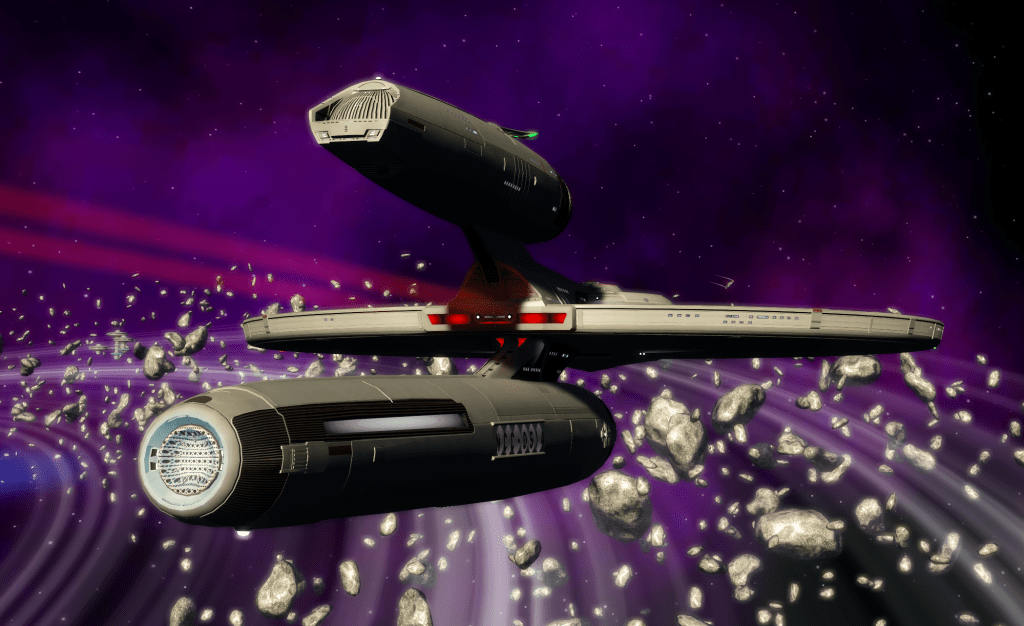
Ever building on what had come before, the Einstein eschewed polarized hull plating in favour of proper deflector shields for defense and was also the first class to feature what we would now recognize as phaser emplacements. Located in four ball turret pairs on the dorsal and ventral surfaces of the primary hull, these emplacements would become a gold standard until the launch of the Ambassador-class and the advent of the collimating strip array 134 years later. To provide additional offensive capabilities in the wake of the Earth-Romulan war without presenting a needlessly threatening appearance that could hamper future first contact or diplomatic efforts, designers chose to mount the Einstein’s impressive array of 12 individual torpedo launchers in retractable turrets, with six each on the ventral and dorsal surfaces. An impressive looking armament on paper, these single tube launchers were slow to reload in practice, thanks in no small part to the complicated linkages necessary to enable them to retract fully into the hull when not in use. Later classes would address this issue via the use of rapid-firing twin tube arrangements that could maintain a similar rate of fire with a significantly reduced space requirement. In addition, as phaser technology continued to advance, the use of proximity detonated torpedoes for point defense was gradually discontinued.
Quietly slated for retirement in the mid-2230’s in favour of the newer and faster Walker and Shepard classes, Einsteins that had survived nearly four decades of expanding the Federations borders and exploring the unknown were consigned to either museums or private ownership. One such vessel is the USS Kelvin. Known primarily for being the ship where one George Samuel Kirk Sr. made history by becoming the then-youngest first officer in fleet history, the Kelvin is the oldest of its class to survive to this day, and the last of the class to be removed from service, having been retired in 2250 after serving time as a cargo vessel and fleet tender. George Kirk’s record would eventually be broken by his own son in 2259, when James T. Kirk became the first officer of the USS Farragut at age 26. Lovingly restored to her “as launched” condition and one of the Fleet Museum’s few fully flightworthy vessels, the Kelvin often makes voyages between Athan Prime and Earth on or near Frontier Day, though was taken offline for maintenance during the events of 2401, thus avoiding destruction at the hands of the compromised fleet at that time.
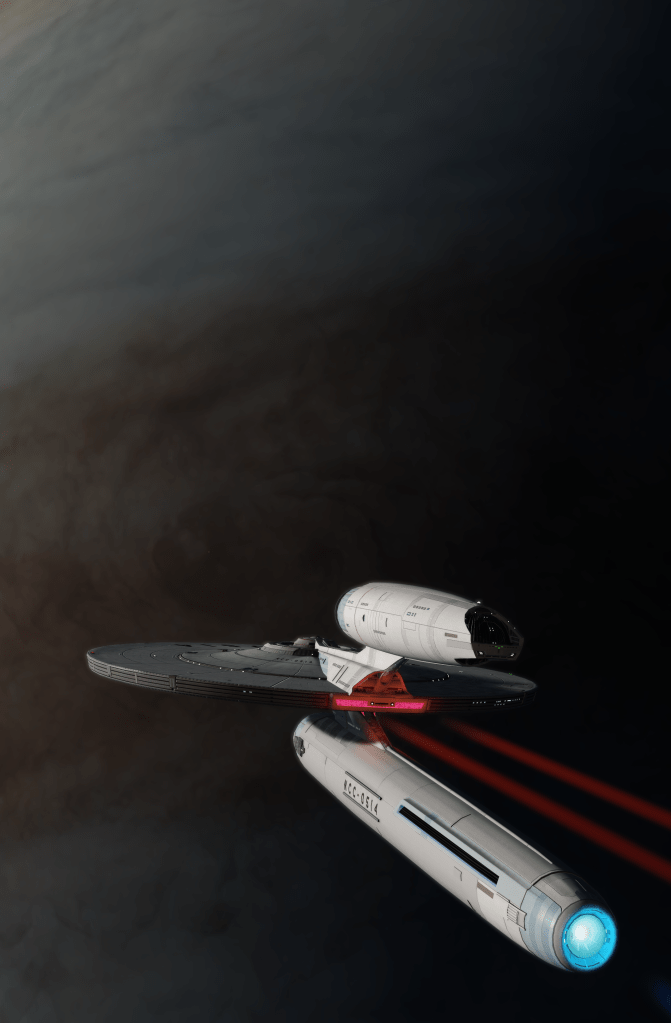
Find out more about Jane’s Interstellar at https://www.facebook.com/fleetsinreview
 Tranquility Press
Leave a comment